Innovative Custom Pools is a dual-licensed Arizona contractor: ROC #333187 (KA-5 pool contractor) and ROC #247627 (KB-2 general contractor). 200+ completed projects across Scottsdale, Paradise Valley, and the greater Phoenix metro since 2020.
Arizona has more swimming pools per capita than any state in the country. That demand has produced hundreds of pool contractors — and a wide range in licensing, capability, and accountability.
For a standard flat-lot build in a tract neighborhood, the difference may not matter much. But for the homeowners ICP works with — on hillside lots in Paradise Valley, NAOS-restricted parcels in North Scottsdale, and estate properties where the pool is one piece of a larger outdoor environment — the builder you choose determines the outcome of a six-figure investment.
Arizona's terrain is genuinely complex. Caliche hardpan, expansive soils, steep slopes, and monsoon drainage requirements create engineering demands that fall outside what a pool-only contractor is legally authorized to address. The licensing framework exists for a reason.
Innovative Custom Pools is a dual-licensed Arizona contractor: ROC #333187 (KA-5 pool contractor) and ROC #247627 (KB-2 general contractor). We've completed 200+ projects across Scottsdale, Paradise Valley, and the greater Phoenix metro since 2020 — including some of the most technically complex hillside builds in the Valley.
If you're planning a custom pool in Arizona, here's what you need to know before you hire anyone.
Every ICP project begins with the site — its grade, its views, its relationship to the home. Pool style follows from that. We build across the full range of luxury pool design, with the engineering depth to execute each one correctly on Arizona's challenging terrain.
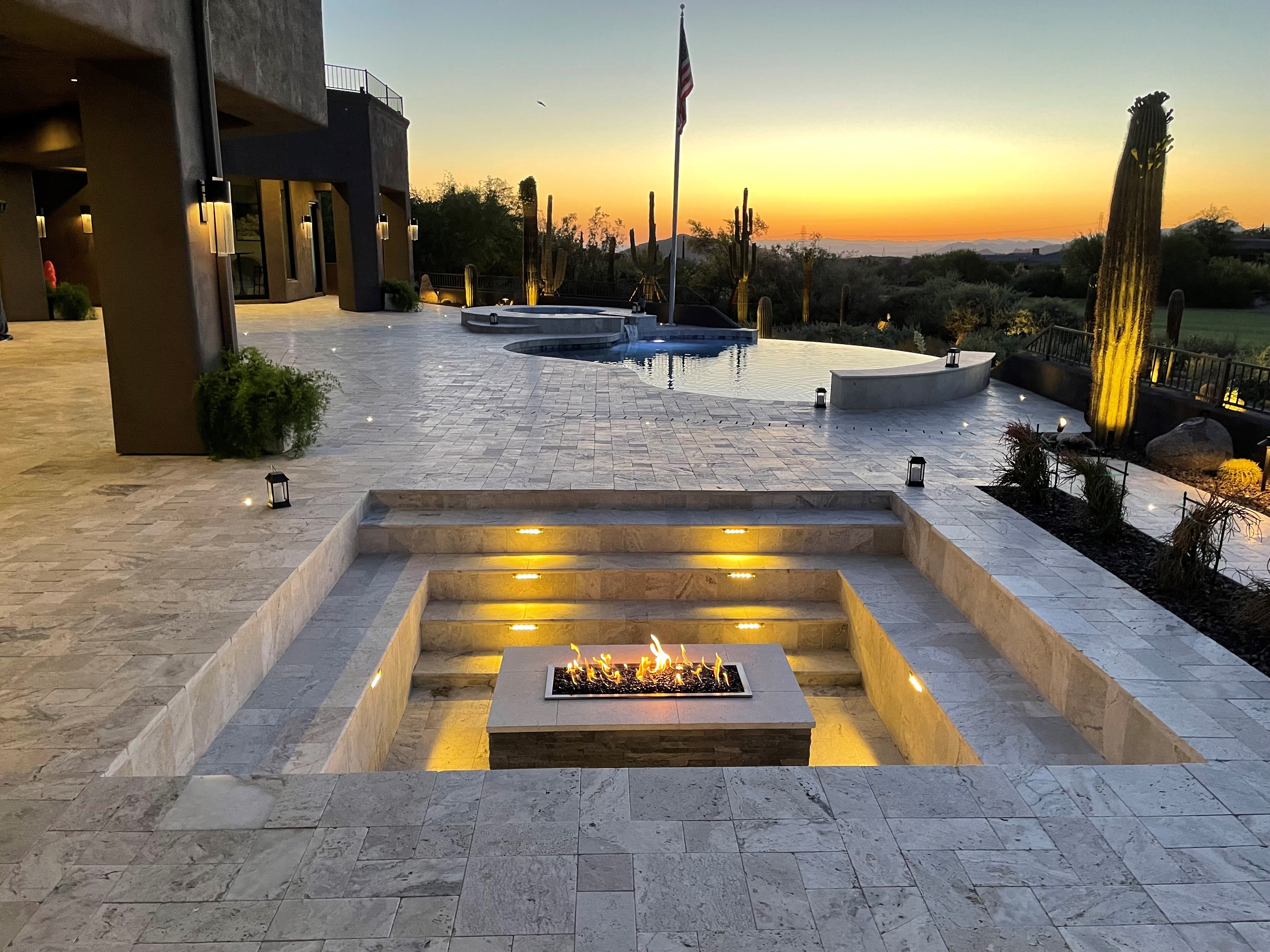
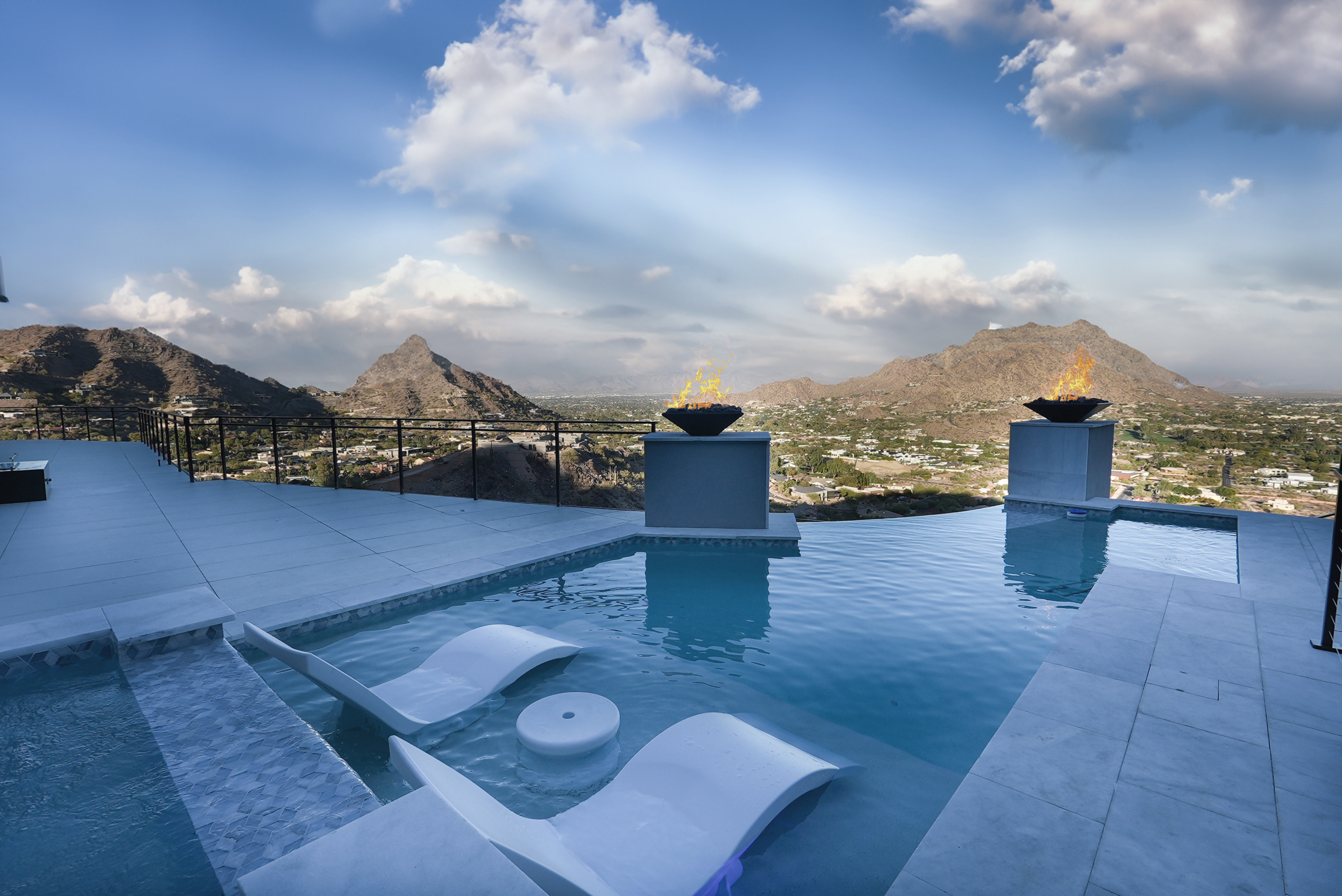
A negative-edge pool is defined by one or more walls that terminate flush with the water surface, creating the visual illusion that the pool extends to the horizon. On a hillside lot in Paradise Valley or North Scottsdale, the effect is transformative. Building one correctly requires precise structural engineering: an integrated catch basin, a level deck within a fraction of an inch, and retaining walls engineered for both soil pressure and water weight simultaneously.
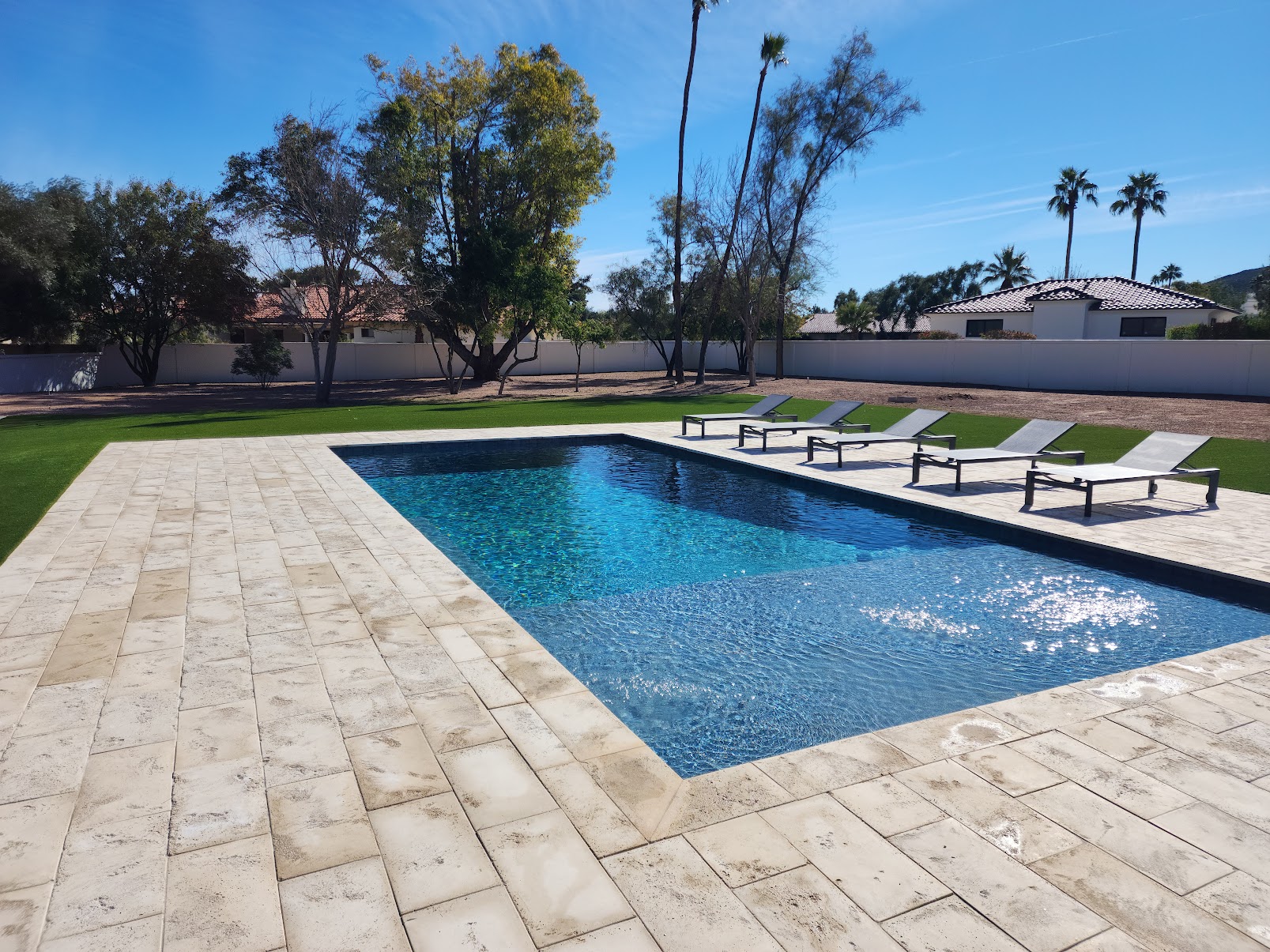
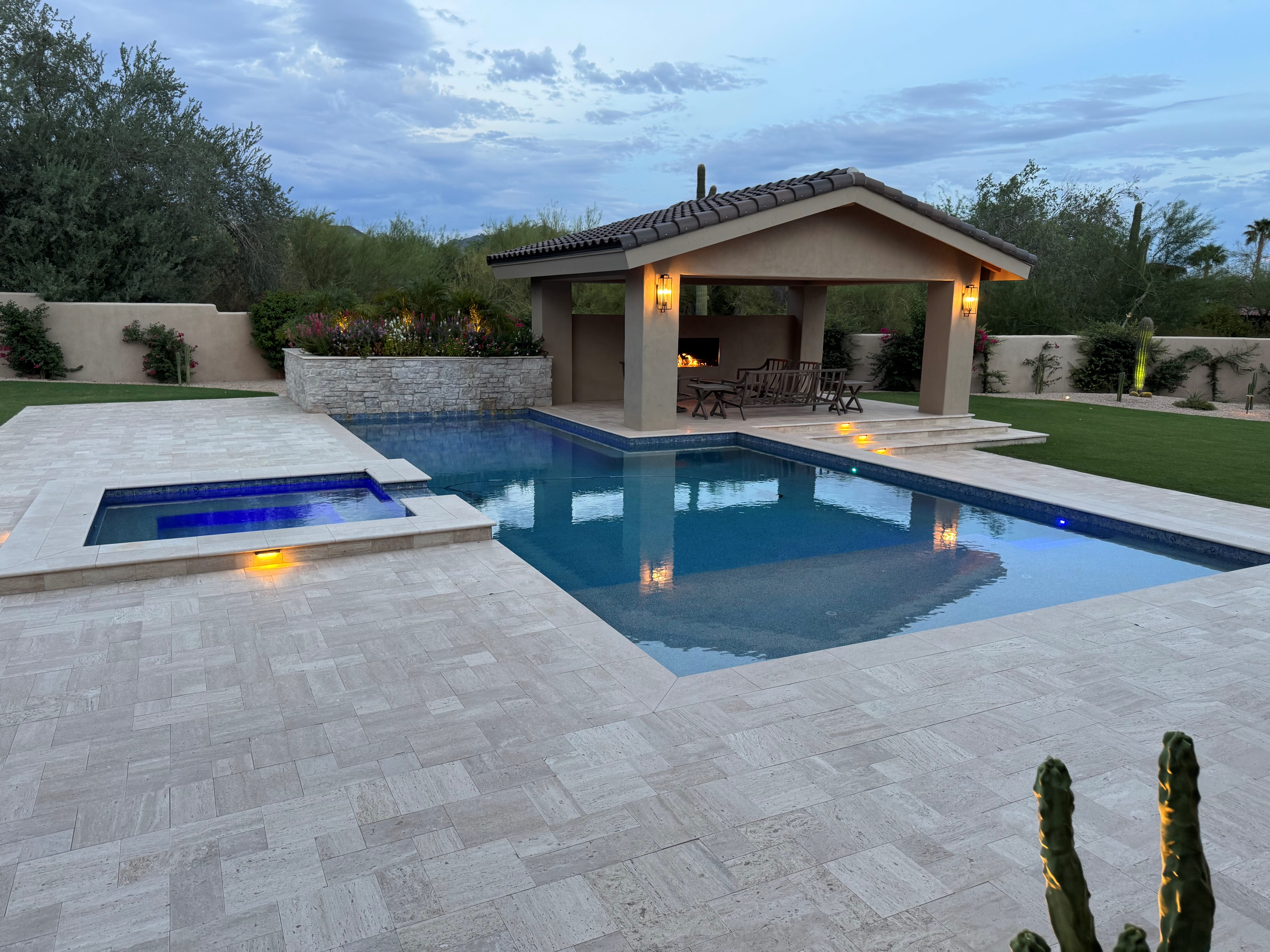
See negative-edge designs →Clean rectangular and multi-rectangular shapes remain the dominant choice in Scottsdale's contemporary architecture market. Geometric pools pair naturally with travertine decking, linear fire features, and the minimalist outdoor kitchens that characterize high-end North Scottsdale builds. We engineer these for both visual simplicity and operational efficiency — clear sightlines from the home, straightforward automation, durable desert-grade finishes.
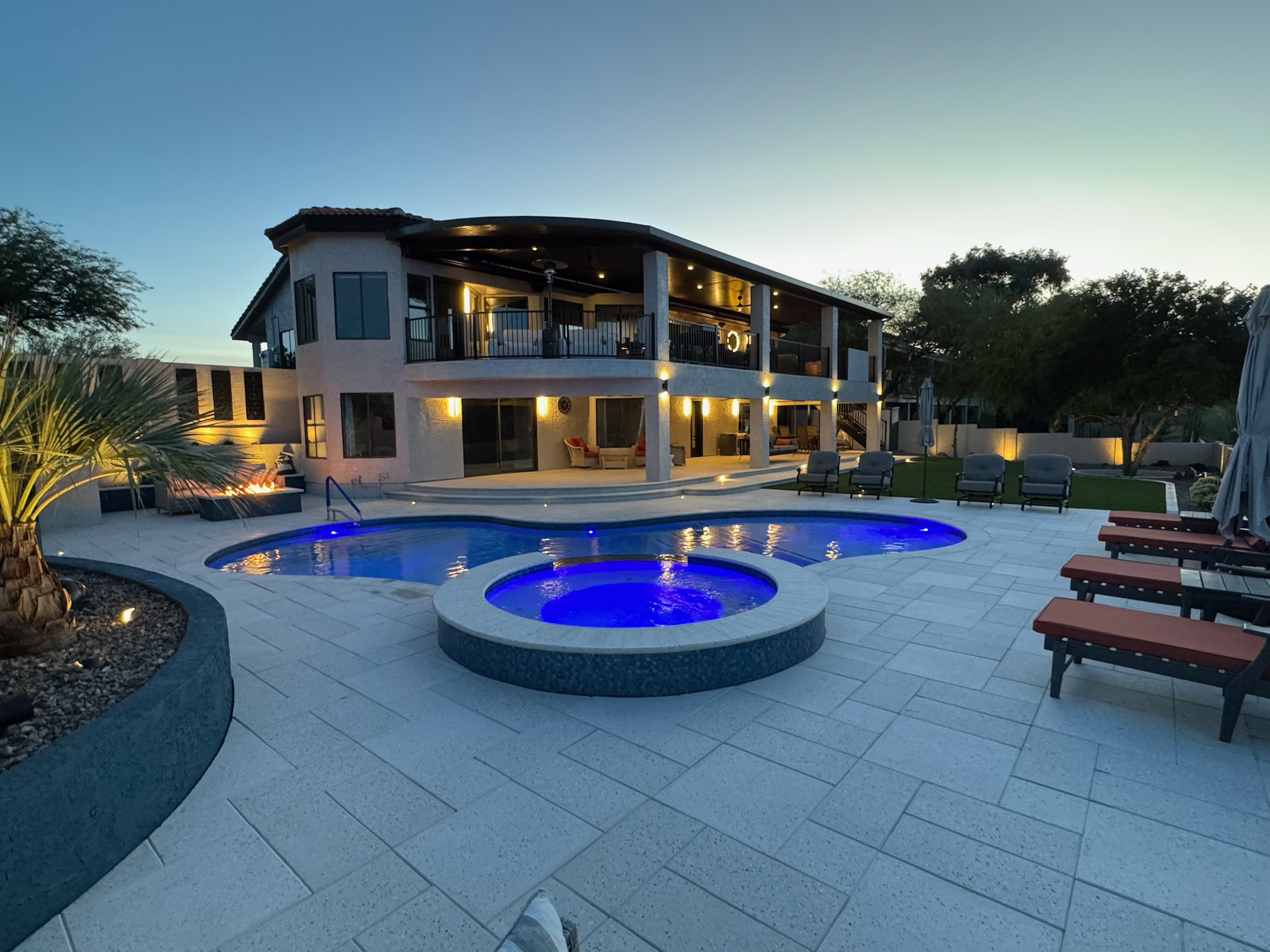
On larger lots — particularly in Paradise Valley's estate neighborhoods — a freeform pool shape creates a naturalistic resort environment. Rock grottos, curved edges, and irregular perimeters are designed to feel like they belong to the landscape rather than imposed on it. We design freeform pools in conjunction with landscaping plans from the start, not as an afterthought.
The projects that define ICP's portfolio are complete outdoor environments: pool, spa, outdoor kitchen, fire features, shade structures, and landscaping designed and built as a single integrated plan under one contract. ICP's KB-2 general contractor license makes this possible without the subcontractor coordination problems that plague multi-contractor builds. One design. One permit set. One point of accountability.
Purpose-built for exercise, lap pools are linear, typically 40–75 feet, and designed to fit lots that can't accommodate a larger freeform shape. They're increasingly popular in Arcadia, the Biltmore corridor, and North Scottsdale estates where the homeowner wants a dedicated fitness amenity without sacrificing the full backyard. We design them with the same finish and automation options as any full-scale ICP build.
A spool — spa-pool hybrid — typically runs 10–16 feet and combines the hydrotherapy jets of a spa with the recreational use of a small pool. On hillside lots where flat buildable area is limited, a cocktail pool is often the right solution: lower excavation cost, smaller structural footprint, and a finished product that feels intentional rather than compromised.
ICP builds complete outdoor environments, not pool shells with upgrades bolted on. Every feature below is available as part of an integrated design — engineered from Day 1, not retrofitted.
Negative-edge spillover spas, sheer descent water walls, deck jets, and naturalistic waterfalls are all designed into the pool plan at the concept stage. Plumbing routes, equipment sizing, and structural requirements are resolved before excavation begins — not discovered afterward. We do not build a pool and add a water feature later. The engineering has to start together.
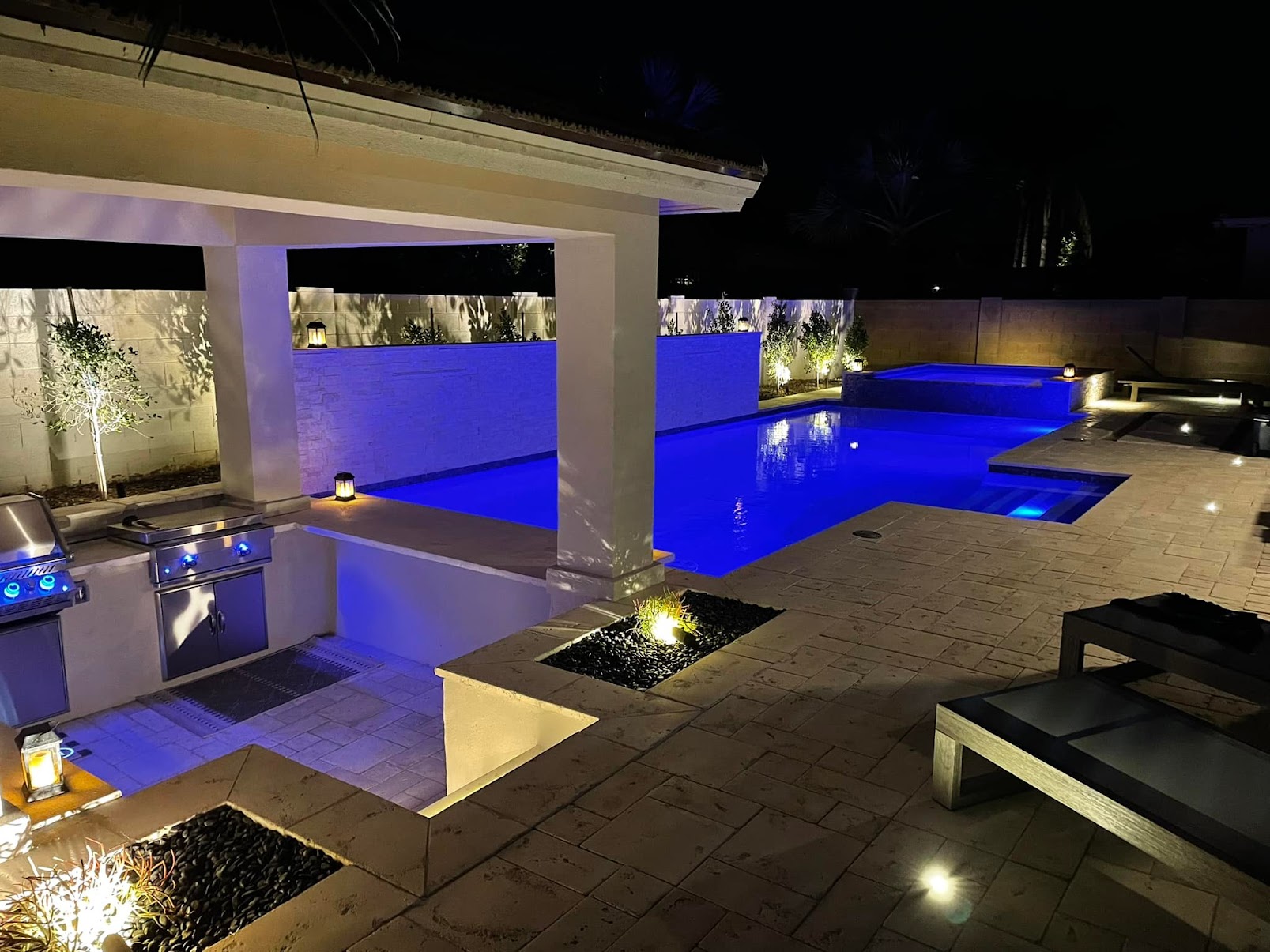
Gas fire bowls, linear fire pits, and fireplaces adjacent to the pool deck are among the most requested elements in luxury Scottsdale builds. So are full outdoor kitchens: built-in BBQ, kegerator, sink, refrigeration, bar seating. A pool-only contractor holding a KA-5 or B-5 license cannot install gas lines or build the structural masonry elements that a kitchen or fire feature requires. ICP's KB-2 covers this scope — no second contractor, no coordination gap.
Travertine pavers are the most popular deck surface in Scottsdale and Paradise Valley for good reason: they're heat-reflective, slip-resistant when wet, and hold up against 100°F+ temperatures without the surface degradation that plagues lower-grade materials. We also build with concrete pavers, porcelain pavers, and acrylic-topped concrete. Every recommendation accounts for Arizona's UV load and thermal cycling.
For Arizona's climate — 100+ days above 100°F, intense UV, hard water — Pebble-Tec and Pebble Quartz are the standard recommendation. They outlast plaster by years in desert conditions, resist UV fading, and hold color better over time. Glass bead finishes add visual sparkle. Standard plaster remains an option at lower cost, but the service life differential in Arizona's environment is significant.
Every ICP build is automation-ready. We spec and install Pentair IntelliConnect, Jandy iAqualink, or equivalent systems — app-based control of pump speed, lighting, water temperature, and chemical dosing. In Arizona's heat, the ability to pre-cool a pool before you arrive or adjust chemistry remotely isn't a convenience feature. It's how a pool is managed in this climate.
This is the section most Arizona pool contractors hope you skip. Read it carefully — it will change what questions you ask when you interview builders.
In Arizona, a contractor building a swimming pool must hold either a B-5 (residential swimming pool, spa, and hot tub) license or a KA-5 (dual commercial and residential swimming pool) license. These licenses authorize the pool shell, associated plumbing, electrical from the service point to pool equipment, and code-required safety barriers. That's the legal scope. Nothing more.
Any structural work beyond the pool itself — retaining walls, outdoor kitchens, ramadas, gas lines to fire features, site grading, drainage structures — falls outside the B-5 and KA-5 scope entirely. To perform that work legally under a single contract, a contractor must also hold a general contractor license.
Most pool contractors in Arizona do not have one.
A KA-5 license is Arizona's dual-designation pool contractor classification — it authorizes residential and commercial pool construction, whereas the B-5 is residential only. ICP holds ROC #333187 (KA-5). For pool construction itself — shell, plumbing, equipment, barriers — the KA-5 covers the full scope of work a homeowner needs.
What license does a pool builder need in Arizona? Arizona pool contractors must hold either a B-5 (residential only) or KA-5 (residential and commercial) license issued by the Arizona Registrar of Contractors. For projects involving structural site work, retaining walls, outdoor kitchens, or gas lines, the contractor must also hold a KB-2 or equivalent general contractor classification. Verify any contractor's license at ROC.az.gov before signing.
A KB-2 license is Arizona's dual commercial and residential general contractor designation. It authorizes structural construction, site improvements, retaining walls, full residential appurtenances, and the broader scope of a complete outdoor environment build. Obtaining it requires a qualifying party with a minimum of four years of documented field experience, passage of the Arizona state contractor exam, and ongoing ROC compliance. ICP holds ROC #247627 (KB-2).
The combination — KA-5 pool contractor and KB-2 general contractor — is what enables ICP to deliver a complete outdoor environment under a single contract, with a single permit set, and a single point of accountability.
A homeowner hires a pool-only contractor for what appears to be a straightforward hillside project. Excavation begins. The contractor encounters a grade change that requires a structural retaining wall to support the pool deck. The retaining wall is outside their license scope, so they bring in a subcontractor — who has a different schedule, a different foreman, and no relationship with the pool contractor's engineer. The wall goes up. Six months later, there's a drainage failure behind the wall because the civil drainage plan was never coordinated between the two contractors.
Or: the homeowner asks for an outdoor kitchen mid-project. The pool contractor can't touch the gas line. A third party is brought in. Permitting opens a new inspection sequence. The kitchen is built to a different grade than the pool deck. The project is three months late and $22,000 over budget — and no single contractor owns the outcome.
ICP's dual license eliminates this. One design, one permit set, one contractor responsible for every element from excavation to final walkthrough.
ICP's Dual-License Advantage — One Contractor, Full Scope
ROC #333187 (KA-5) and ROC #247627 (KB-2) mean that every element of your outdoor environment — pool shell, spa, retaining walls, outdoor kitchen, gas fire features, shade structures, decking, drainage — is designed, permitted, and built under one contract by one licensed contractor. You have one point of contact, one construction timeline, one warranty conversation, and one entity legally accountable for the outcome. Verify both licenses at ROC.az.gov before you hire anyone.
Arizona's construction environment is unlike anywhere else in the country. Four site conditions affect almost every build in the Phoenix metro, and how your contractor handles them — before you sign, not after excavation — determines whether your project finishes on budget.
Caliche is a calcium carbonate hardpan that occurs naturally across Maricopa County, typically at depths that intersect directly with pool excavation. It ranges from a soft, crumbly layer to solid rock that requires jackhammering or blasting to remove. It is not predictable from the surface.
ICP walks every site before pricing. We assess visible surface indicators, review soil maps for the parcel, and — when warranted — recommend a geotechnical investigation before design begins. If there's caliche on your site, we tell you before you sign, not after excavation starts. A builder who lists caliche as an "unforeseen condition" in their contract is telling you something important about how they operate.
Clay-rich expansive soils are common in Queen Creek, the East Valley, and flood-irrigated parcels throughout the metro. These soils absorb water and swell — then shrink and crack as they dry. The cyclical movement creates real structural risk: shell cracking, unlevel decking, and plumbing failures that can develop years after construction.
Mitigation options include chemical soil stabilization, over-excavation with engineered backfill, and flexible design approaches. ICP identifies expansive soil risk during the site walk and specifies the appropriate engineering approach before design is finalized.
Arizona's monsoon season runs June 15 through September 30. Both Scottsdale and Paradise Valley require on-site retention of the 100-year, 2-hour storm event — meaning your pool deck design must incorporate engineered drainage structures. This is a permitting requirement, not an optional upgrade.
ICP designs drainage systems into the pool deck plan from the first site assessment. A contractor who discovers the requirement after permit submission will add it as a change order. We price it in.
Phoenix averages more than 100 days per year above 100°F. That thermal load accelerates UV degradation of pool finishes, equipment seals, and deck surfaces in ways that don't occur in most other U.S. markets.
ICP specifies desert-grade materials as standard: Pebble-Tec or Pebble Quartz interior finishes, UV-resistant equipment housings, heat-reflective travertine or porcelain decking. These are not premium upgrades in Arizona's climate. They are the correct specification for the environment.
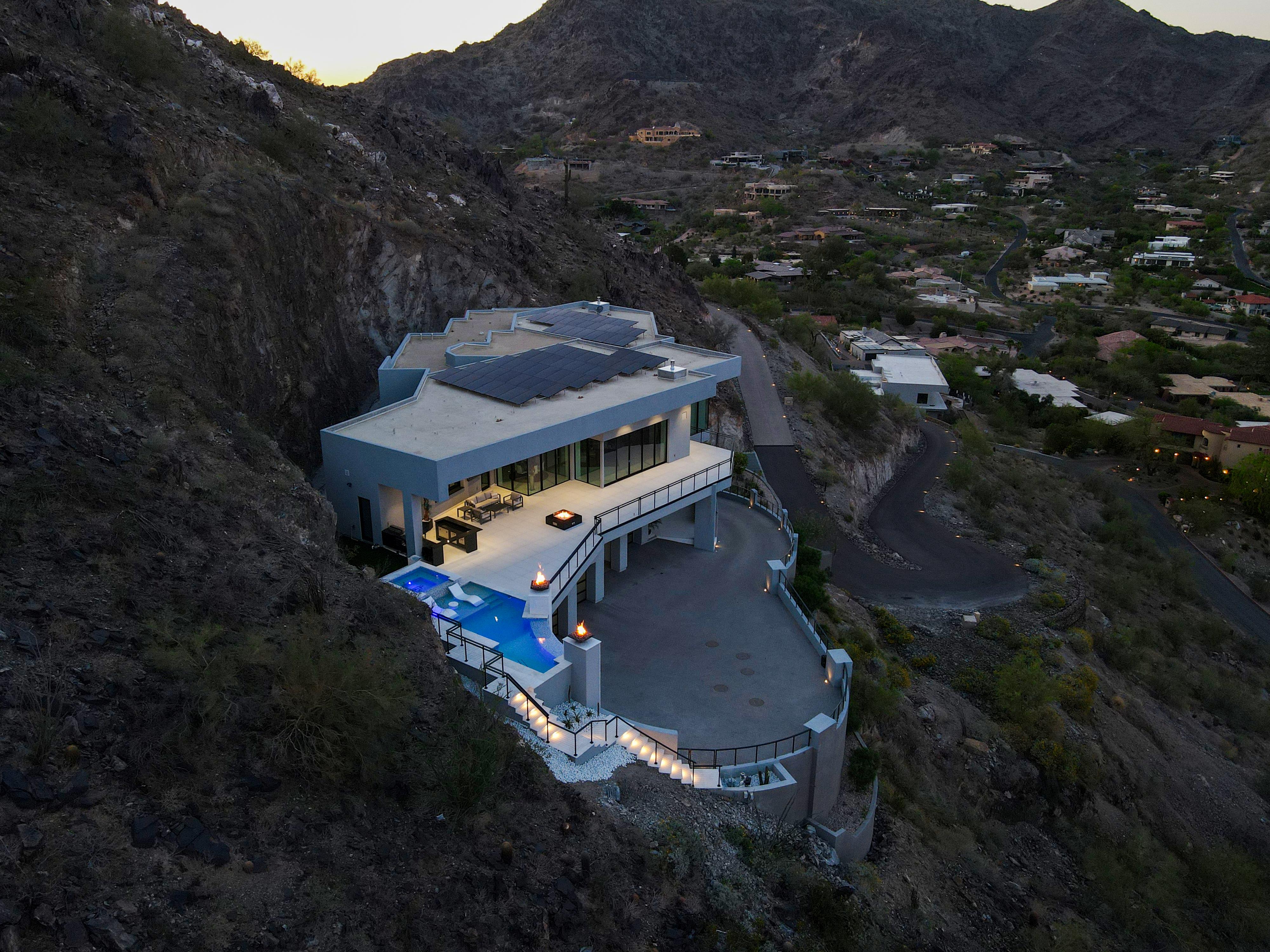
Paradise Valley's hillside estates and Scottsdale's North Mountain neighborhoods produce some of the most visually spectacular pool sites in the country — and some of the most technically demanding. Grades that deliver panoramic views also require engineering that most pool contractors have never performed.
ICP's hillside process begins before design. A topographic survey establishes the site's slope geometry. A geotechnical analysis identifies soil bearing capacity, bedrock depth, and groundwater conditions. From there, a structural engineer specifies retaining wall design, friction pile requirements, and the phased construction sequence that gets heavy equipment onto a steep site safely.
Hillside builds typically add two to four months to the construction timeline compared to flat-lot projects. They cost more. They require more engineering documentation for permitting. And they produce finished environments that flat-lot builds simply cannot replicate. For the right site, there is no better investment. Learn more about our hillside pool engineering process →
On slopes exceeding specific grade thresholds, a pool shell must be anchored to bedrock using friction piles — steel pins driven to refusal depth to prevent shell migration over time. This is a structural requirement, not a precaution. ICP designs friction pile specifications based on the geotechnical report for each site, not from a generic standard.
A retaining wall holding a pool deck is a structural element — it carries the weight of the deck surface, the water in the pool, furniture, and human loads, against the lateral pressure of retained soil. It must be engineered to code, not landscaped. A pool-only contractor cannot build structural retaining walls under their license. ICP's KB-2 covers this scope, and our retaining walls are designed by a licensed structural engineer and permitted accordingly.
Many Paradise Valley and North Scottsdale hillside lots have no viable access path for standard excavation equipment. Getting a pool shell in the ground requires micro-excavators, crane lifts for materials, and a phased construction staging plan that accounts for equipment clearance, neighbor access, and grade stability at every phase. ICP plans for this in the initial estimate — it is not a change order.
Every ICP project follows the same six-phase sequence. The phases are not rushed. The goal is a finished environment that performs correctly for decades — not a pool that's done in eight weeks and generates warranty calls in year two.
Every project begins with a site walk. We assess topography, surface indicators for caliche and expansive soil, natural drainage patterns, grade and elevation change, NAOS boundary locations, and equipment access conditions. The site walk sets realistic scope. It is the step that prevents change orders.
Pool shape, style, and features are developed alongside the outdoor environment plan — deck materials, kitchen layout, fire feature placement, shade structures — as a single integrated design. We produce 3D renderings so you can visualize the finished environment before any earthwork begins. Revisions happen at the design stage, not during construction.
We prepare and submit the full permit package to the relevant jurisdiction: City of Scottsdale, Town of Paradise Valley, or City of Phoenix. For complex builds, this includes stamped structural calculations, civil drainage plans, and — for Paradise Valley hillside projects — Hillside Building Committee submittals with 3D massing models, material samples, and LRV compliance documentation. Timeline: two to four weeks for a standard Scottsdale flat-lot permit; three to six months for a Paradise Valley hillside HBC path.
Site excavation, caliche removal where present, soil stabilization where required, structural retaining wall installation, and friction pile placement on hillside builds. The structural phase is the one most likely to surface surprises on sites where a pre-build geotechnical investigation was not performed. On ICP projects, the site walk and soil analysis mean we've already accounted for what's in the ground.
Steel reinforcement cage, shotcrete or gunite shell application, plumbing rough-in, electrical, and equipment installation — pump, heater, automation controller, lighting. Tile and coping are installed at the end of this phase. Equipment selection and placement account for Arizona's thermal load and the automation system the homeowner wants at completion.
Deck surface installation, interior finish application, water features, outdoor kitchen, fire features, shade structures, and final landscaping. Pool startup, chemistry balancing, equipment commissioning, and owner walkthrough. At the walkthrough, we review automation operation, maintenance requirements, and warranty coverage. You leave knowing exactly how to operate what we built.
No competitor has published a clear jurisdiction-by-jurisdiction comparison of Arizona pool permit requirements. Here is what the process actually looks like in the three primary jurisdictions ICP works in.
Pool permit applications in Scottsdale are submitted to Planning & Development Services. After intake, plan review runs 10–15 business days — but intake queue adds another five to ten days, so budget three to four weeks for a standard flat-lot permit from submission to approval. There is no expedited review option.
Required documentation includes a full lot-scale site plan showing setbacks, equipment location, easements, and NAOS buffer compliance (minimum five-foot construction setback). Custom pools require stamped structural calculations. Complex or hillside builds extend to four to eight weeks.
Paradise Valley is the most restrictive permitting jurisdiction in the Phoenix metro. Any pool project on a hillside lot follows a four-phase path:
Pool tied to new home construction in PV: six to nine months is a realistic total timeline. ICP has navigated this process multiple times. We know what PV staff needs before they ask for it.
Standard Phoenix flat-lot pool permits follow a two-to-four week timeline, similar to Scottsdale. Phoenix has hillside overlay provisions that trigger at specific slope thresholds, requiring slope analysis and additional engineering documentation.
One important distinction: Paradise Valley Village — a neighborhood that carries the PV name — is actually within the City of Phoenix boundaries and uses Phoenix zoning standards, not Town of Paradise Valley ordinances. If your property address says Paradise Valley, verify the jurisdiction before assuming the PV permitting path applies.
Custom pool pricing in Arizona is driven by site conditions more than style choices. Here is how ICP thinks about project cost on complex Arizona builds.
| Project Type | Typical Range (Scottsdale / PV) |
|---|---|
| Entry-level (flat lot, standard features) | $50,000 – $75,000 |
| Mid-range (luxury features, moderate complexity) | $75,000 – $120,000 |
| Premium (resort environment, outdoor kitchen, spa) | $120,000 – $200,000+ |
| Hillside / complex site premium | +$25,000 – $100,000+ depending on structural requirements |
On a flat, accessible lot with no soil complications, a well-finished custom pool with automation, quality interior finish, and travertine decking lands in the $75,000–$120,000 range for most Scottsdale builds. Add a spa, outdoor kitchen, and fire feature, and the project moves into the $150,000–$200,000+ range. These are the projects where ICP's dual licensing delivers the most obvious value — everything under one contract, one permit, one builder.
Hillside projects in Paradise Valley and North Scottsdale start at a higher baseline because the structural engineering, permit path, and construction logistics are fundamentally different. A complete hillside negative-edge pool environment in Paradise Valley — pool, spa, retaining walls, outdoor kitchen, fire features — is realistically a $250,000–$500,000+ investment depending on the site's complexity and scope. See our hillside pool engineering process →
On complex builds — particularly those requiring stamped structural calculations, civil drainage plans, or NAOS revegetation compliance — permitting-related costs including engineering reports, plan preparation, and permit fees can add $8,000–$20,000 to project cost. ICP prices these into the initial proposal rather than presenting them as change orders after permit review. Detailed Scottsdale cost breakdown →
Innovative Custom Pools serves the greater Phoenix metropolitan area with primary concentration in the luxury markets of Scottsdale and Paradise Valley. Our construction team is based in the Valley and does not subcontract to regional crews — the same team that builds in Paradise Valley builds everywhere we work.
If your property is outside the areas listed above, contact us — we take select projects outside our core service area on a case-by-case basis.
Arizona pool contractors must hold either a B-5 (residential swimming pool, spa, and hot tub) or KA-5 (dual commercial and residential pool) license issued by the Arizona Registrar of Contractors. For projects involving structural retaining walls, outdoor kitchens, gas lines, or site improvements beyond the pool itself, the contractor must also hold a general contractor license — typically KB-2. Verify any contractor's license at ROC.az.gov before signing a contract.
A KA-5 is Arizona's dual-designation pool contractor license, authorizing both commercial and residential pool construction. It covers the pool shell, associated plumbing, electrical from the service point to pool equipment, and code-required safety barriers. ICP holds ROC #333187 (KA-5). The KA-5 does not authorize structural site work, gas lines, outdoor kitchens, or retaining walls — those require a separate general contractor designation.
A pool contractor (B-5 or KA-5) is licensed to build the pool shell and directly associated systems. A general contractor (such as KB-2) is licensed to build structural elements — retaining walls, outdoor kitchens, ramadas, gas infrastructure, and site improvements. On any project involving structural site work or a complete outdoor environment, you need a contractor who holds both licenses — or you need to hire and coordinate two separate licensed contractors yourself.
It depends on jurisdiction and site complexity. Scottsdale standard flat-lot: two to four weeks. Scottsdale complex or custom: four to eight weeks. Phoenix flat-lot: two to four weeks. Paradise Valley hillside (four-phase HBC path): three to six months. These timelines are from permit submission to approval — they do not include the design and engineering work that must be completed first.
Custom pool pricing in Scottsdale ranges from approximately $50,000 for a straightforward flat-lot build to $200,000+ for a full resort environment with spa, outdoor kitchen, and fire features. Hillside builds carry an additional premium driven by structural engineering, equipment staging, and extended permitting. See our detailed Scottsdale cost breakdown →
A flat-lot build in Scottsdale or Phoenix runs three to five months from permit approval to completion. Add two to four weeks for the permit phase on a standard Scottsdale build. Hillside builds in Paradise Valley run six to twelve months total when the full HBC permitting path is included.
Caliche is a calcium carbonate hardpan that occurs naturally across Maricopa County, often at depths that intersect directly with pool excavation. It ranges from a crumbly layer to solid rock requiring jackhammering or blasting to remove. Caliche is not predictable from the surface. ICP walks every site before pricing and assesses for caliche indicators before any contract is signed. A builder who lists caliche as an "unforeseen condition" is transferring cost risk to you after excavation.
Not under their pool license. A B-5 or KA-5 pool contractor's license covers the pool shell, plumbing, electrical to pool equipment, and code barriers — nothing more. Structural retaining walls, outdoor kitchens, gas lines, and site improvements require a general contractor license (such as KB-2). ICP holds both — ROC #333187 (KA-5) and ROC #247627 (KB-2) — enabling us to build the complete outdoor environment under a single contract.
The Hillside Building Committee (HBC) is the Town of Paradise Valley's design review body for construction on hillside lots. Any pool or structure on a PV hillside property must receive HBC approval before a building permit is issued. The HBC review requires 3D massing models, material samples, sealed grading plans, Light Reflectance Value documentation, and a 100-year storm event drainage study. Review typically takes four to eight weeks after a complete submittal. ICP has guided multiple clients through the full HBC process.
NAOS stands for Natural Area Open Space — a designation applied to portions of parcels in North Scottsdale that must be preserved in their natural state. Most NAOS areas require a minimum five-foot construction setback, and any disturbed NAOS area must be revegetated with native plants following construction. NAOS boundaries are recorded on your plat and must be shown on any permit submission. ICP maps NAOS boundaries at the site walk and designs accordingly.
Start with license verification at ROC.az.gov. Confirm the contractor holds a current, active license with no disciplinary actions. For any project involving structural site work, a complete outdoor environment, or a hillside lot, confirm they hold a general contractor license in addition to their pool license. Ask for references on projects similar in complexity to yours. Ask directly how they handle caliche: before or after you sign. A contractor with a single point of accountability across the full project scope is worth more than a cheaper bid that brings in subcontractors.
Arizona requires a minimum four-foot barrier around any residential swimming pool — a wall, fence, or combination — with self-closing, self-latching gates. The barrier must be designed to prevent unassisted access by children under five. Scottsdale and Paradise Valley may have additional requirements; ICP addresses barrier compliance as part of the permit package and construction scope on every project.
A negative-edge pool — also called a vanishing-edge or infinity pool — has one or more walls that terminate at the water surface, creating the visual effect that the pool extends to the horizon. The water flows over the edge into a catch basin below and is recirculated back to the pool. On a hillside lot with a view, the effect is striking. Building one correctly requires precise structural engineering and leveling. Learn more about ICP's negative-edge designs →
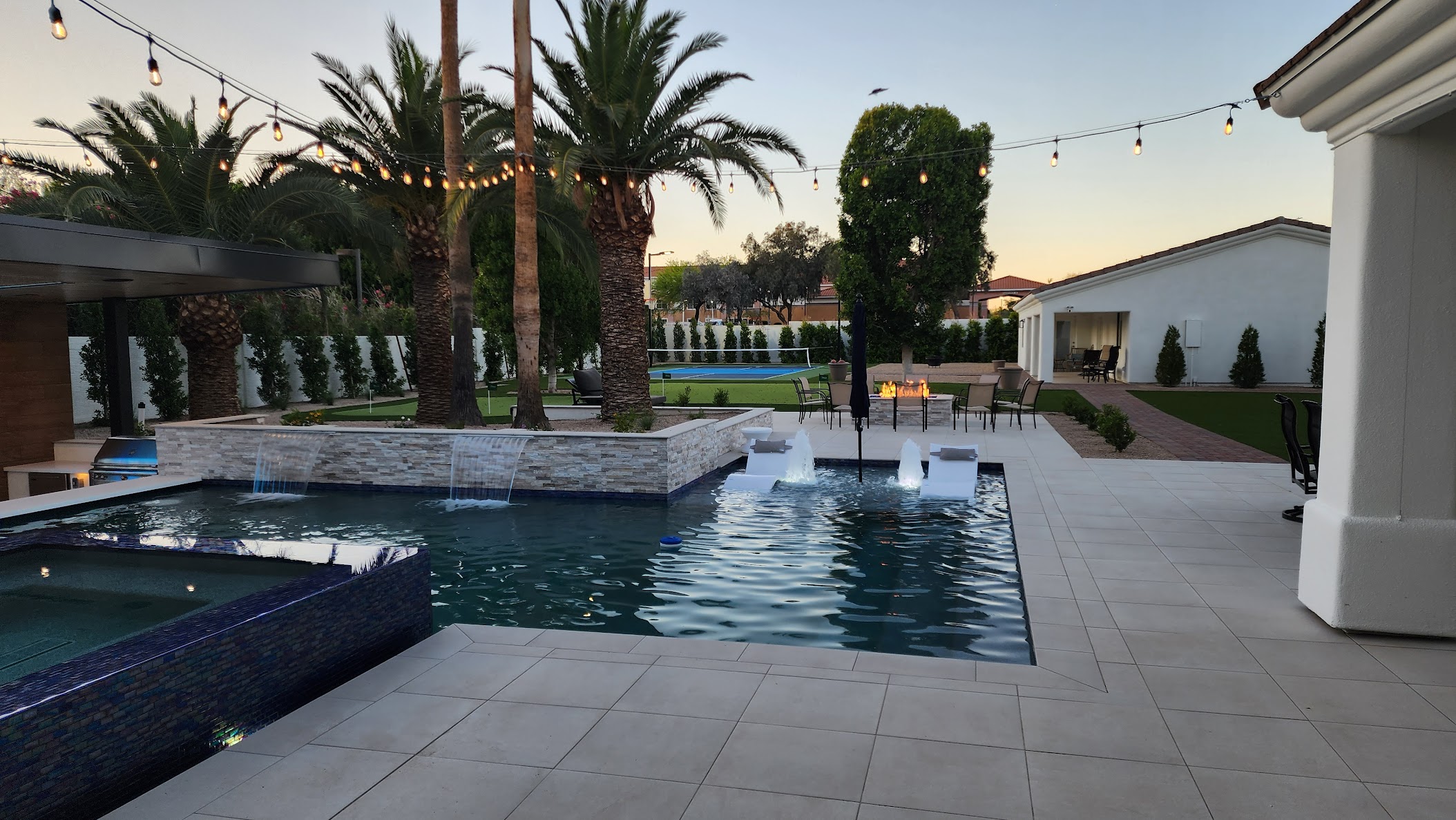
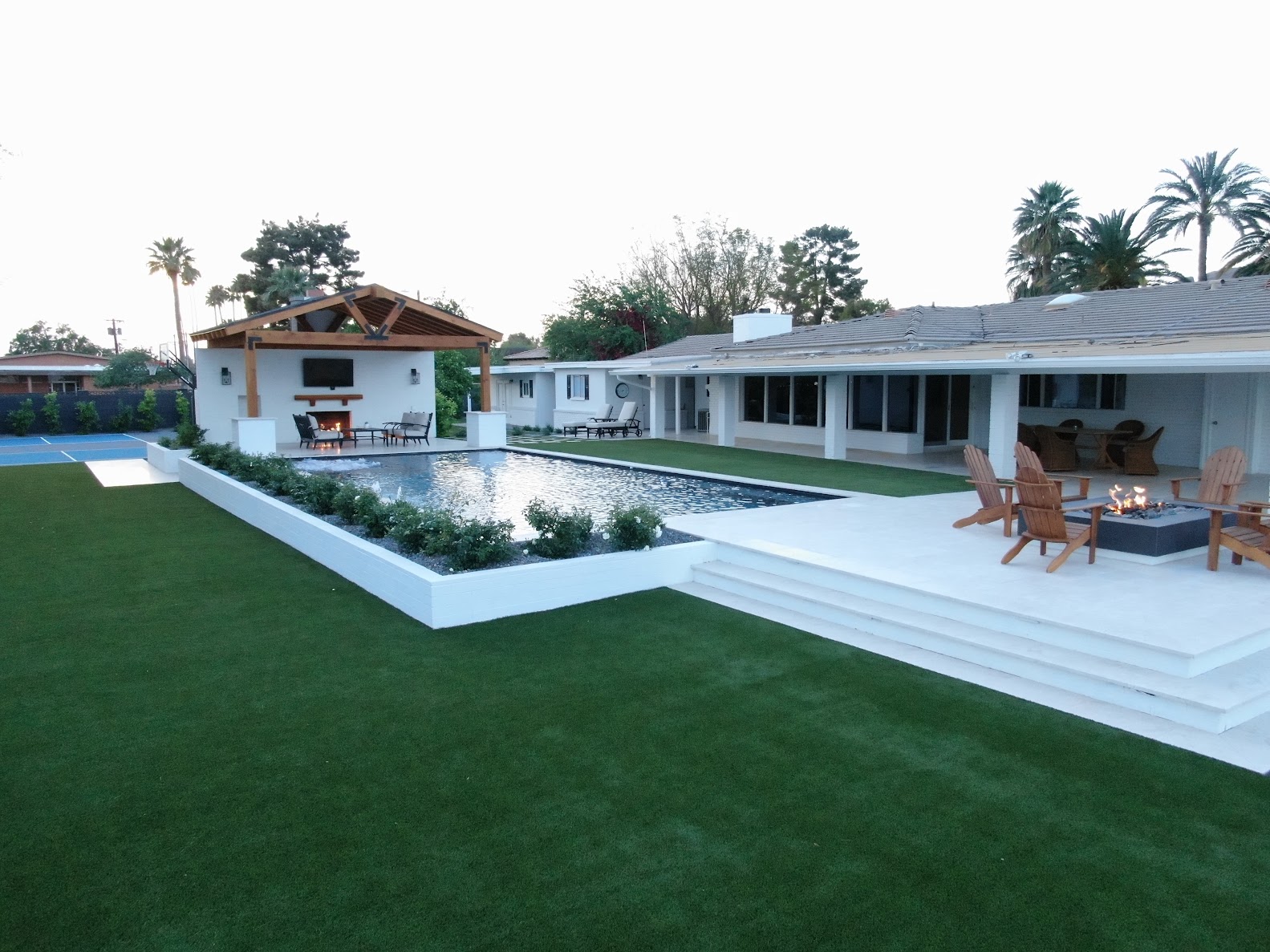
ICP's portfolio includes 200+ completed projects across Scottsdale, Paradise Valley, and the greater Phoenix metro. The work below represents the range of site conditions and environments we build.
No filler. Here is why our clients hire us and why they refer us.
We'll walk it, assess the conditions, and give you an honest scope and timeline before you commit to anything.